
Vitamin K2 and Fatty Liver: Can It Improve NAFLD?
A recent animal study published in Scientific Reports (Nature Portfolio) examined the metabolic health benefits of Vitamin K2, focusing on its effects in a high-fat diet (HFD)-induced non-alcoholic fatty liver disease (NAFLD) mouse model.
The study quantitatively analyzed how Vitamin K2 supplementation influenced body weight, adiposity, liver weight, hepatic triglyceride levels, and liver tissue damage. Beyond simple weight reduction, the findings suggest that Vitamin K2 may help suppress fat accumulation, reduce liver triglycerides, and alleviate liver tissue injury—highlighting its potential role in metabolic health improvement and NAFLD management.

0️⃣ Study Design: Evaluating Vitamin K2 in an HFD-Induced NAFLD Model
Researchers induced NAFLD in mice by feeding them a high-fat diet (HFD) for 12 weeks.
Experimental Groups
- C: Normal diet control
- C + VK2: Normal diet + Vitamin K2
- HFD: High-fat diet
- HFD + VK2 (L): High-fat diet + 0.1 mg/kg Vitamin K2
- HFD + VK2 (M): High-fat diet + 0.2 mg/kg Vitamin K2
- HFD + VK2 (H): High-fat diet + 0.4 mg/kg Vitamin K2
- HFD + V: High-fat diet + vehicle only
1️⃣ Vitamin K2 and Body Weight Reduction
- The HFD group showed approximately 1.3-fold higher body weight gain compared to the normal diet group.
- Vitamin K2-treated groups demonstrated about 25% suppression of weight gain compared to the HFD group.
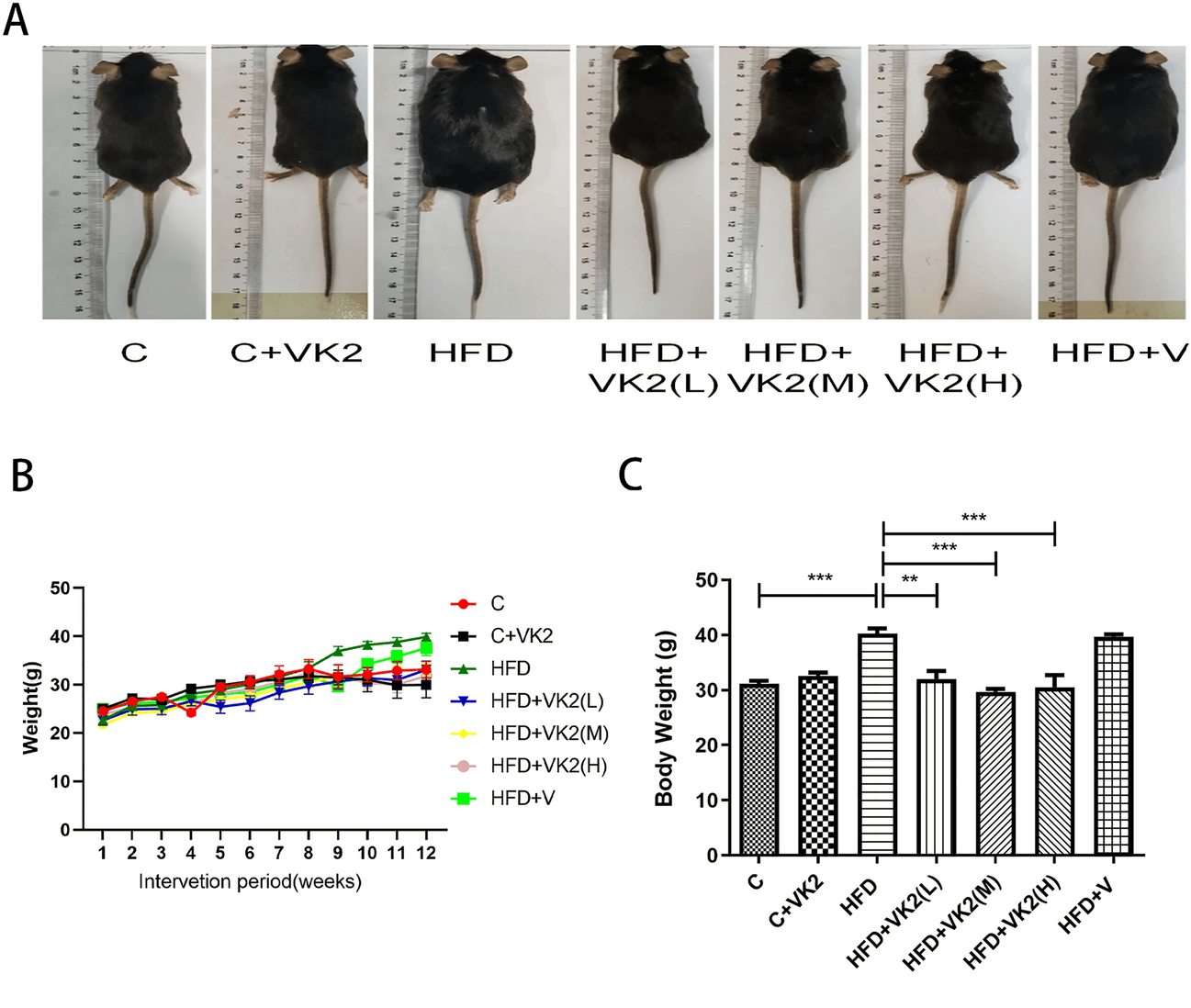
- (A) Effects of vitamin K2 on Body size in high-fat diet fed mice for 12 weeks.
- (B) Effects of vitamin K2 on body weight changes of each group.
- (C) Effects of vitamin K2 on body weight in 12 weeks.
These findings suggest that Vitamin K2 significantly inhibits fat accumulation even under high-fat dietary conditions.
2️⃣ Vitamin K2 and Reduction in Adiposity
- The HFD group exhibited nearly 3-fold higher fat mass compared to the control group.
- Vitamin K2 supplementation resulted in roughly a 2-fold significant reduction in fat mass.
- Importantly, lean mass and fluid distribution remained unchanged.
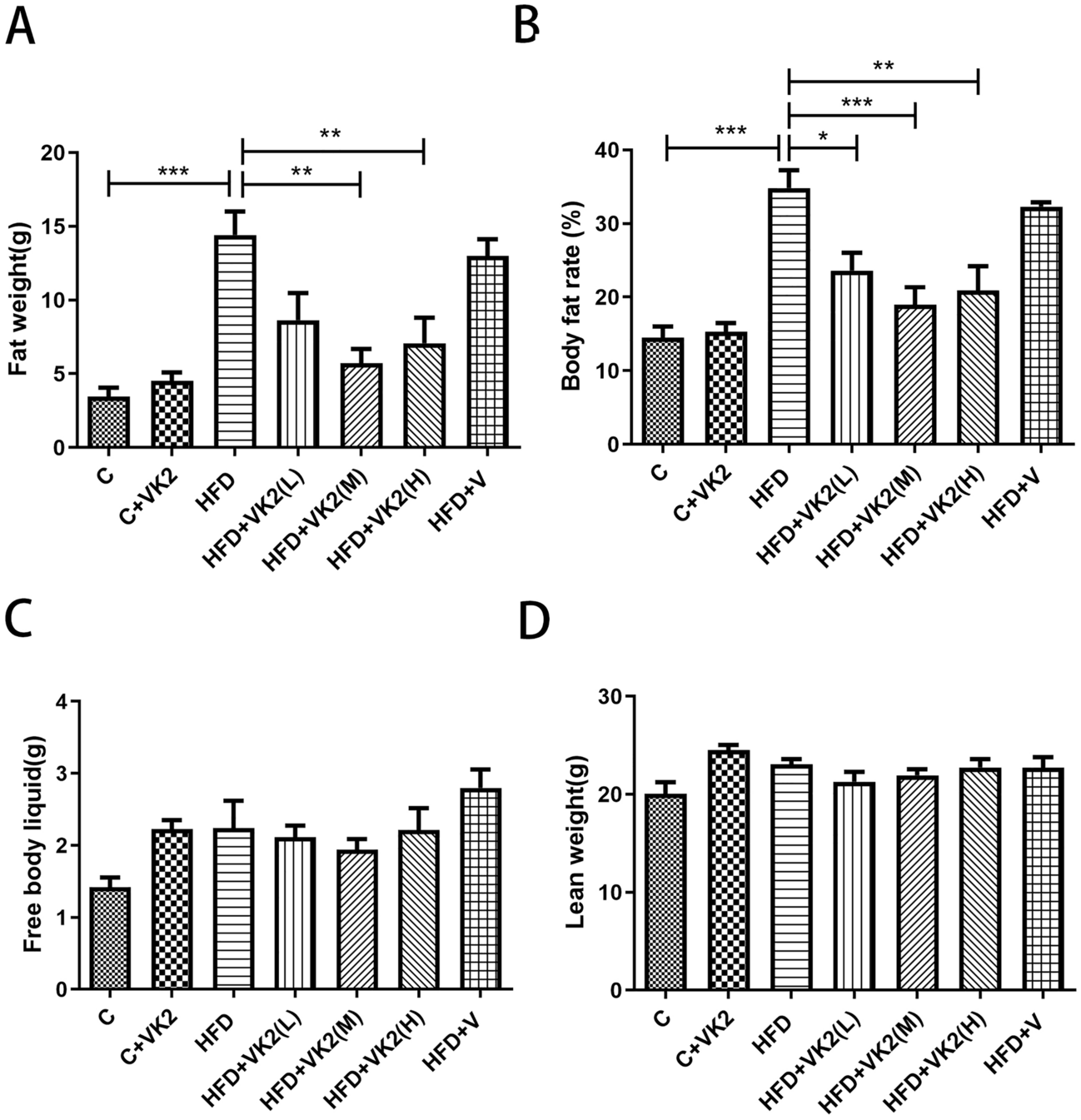
- (A) Body fat weight of mice on a high-fat diet for 12 weeks.
- (B) Body fat rate of mice on a high-fat diet for 12 weeks.
- (C) Free body liquid weight of mice on a high-fat diet for 12 weeks.
- (D) Lean weight of mice on a high-fat diet for 12 weeks.
This indicates that Vitamin K2 selectively reduces fat mass without negatively affecting lean body mass, which is particularly important in metabolic health interventions targeting obesity and NAFLD.
3️⃣ Vitamin K2 and Improvement in Non-Alcoholic Fatty Liver Disease (NAFLD)
Liver tissue changes are the most critical indicators in NAFLD models.
- The HFD group showed approximately 2.8-fold increases in liver weight and liver index compared to the control group.
- Vitamin K2 supplementation significantly reduced liver weight.
- Hepatic triglyceride levels were also markedly decreased in Vitamin K2-treated groups.

- (A) Effects of vitamin K2 on Liver specimens in high-fat diet fed mice.
- (B) Effects of vitamin K2 on Liver weight in high-fat diet fed mice.
- (C) Effects of vitamin K2 on Liver index in high-fat diet fed mice.
These findings suggest that Vitamin K2 may improve hepatic fat accumulation and reduce macroscopic liver damage in NAFLD.
Non-alcoholic fatty liver disease (NAFLD) is one of the fastest-growing metabolic disorders worldwide and is closely linked to obesity and insulin resistance. Since effective therapeutic options remain limited, evidence-based nutritional interventions are gaining increasing importance.
This study provides foundational preclinical data supporting the potential expansion of Vitamin K2’s role in metabolic health, obesity management, and fatty liver improvement.